Here's another mode of expectation, an expectation that was more than what I could devise in my mind. There were essays that I have put together that may seem eccentric by the mere semblance that it carried. Some of them were more than eccentric. One of my major flaws, albeit, is introductions. For the life of me I can't write well in the beginning of a writing endeavor. Why is that? I wish I knew, but it is there, notwithstanding. So then, what am I to do with this impediment? I've read books on writing (maybe not enough?). Who knows? Perhaps you can give me a hand in this query. How do you begin your writing assignments? And what advice can you offer me?
Monday, March 19, 2007


There Was a Problem
Here is something that I need to learn. And here it was. I was at home, and to my surprise I found my computers working properly (finally). I couldn't believe it. I really don't like Vista (I have the Business version).
Wednesday, March 07, 2007
Bertrand Russell and the Decalogue: a new law
Disclaimer: This is by no means my view of the Decalogue (the new one Russell presents). I just thought this would be good to note, for those of you who like philosophy. Enjoy.
A LIBERAL DECALOGUE
By Bertrand Russell
1. Do not feel absolutely certain of anything.
2. Do not think it worth while to proceed by concealing evidence, for the evidence is sure to come to light.
3. Never try to discourage thinking for you are sure to succeed.
4. When you meet with opposition, even if it should be from your husband or your children, endeavor to overcome it by argument and not by authority, for a victory dependent upon authority is unreal and illusory.
5. Have no respect for the authority of others, for there are always contrary authorities to be found.
6. Do not use power to suppress opinions you think pernicious, for if you do the opinions will suppress you.
7. Do not fear to be eccentric in opinion, for every opinion now accepted was once eccentric.
8. Find more pleasure in intelligent dissent than in passive agreement, for, if you value intelligence as you should, the former implies a deeper agreement than the latter.
9. Be scrupulously truthful, even if the truth is inconvenient, for it is more inconvenient when you try to conceal it.
10. Do not feel envious of the happiness of those who live in a fool's paradise, for only a fool will think that it is happiness."
"A Liberal Decalogue" is from The Autobiography of Bertrand Russell, Vol. 3: 1944-1969, pp. 71-2.
Thursday, March 01, 2007
Van Til and Calvin on Man
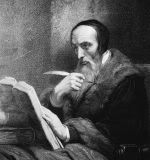
I have notables of the Christian faith, such as Cornelius Van Til, who by their faith have confessed and further deliberated a true nature of man as distinct from God. As I was reading Van Til's The Defense of the Faith, I couldn't help but look at the study of man. I recently finished the section of the study of man in Calvin's Institutes, which did clarify some of the notions of the noetic effects of sin and such. There was one sentence--or more properly, a paragraph--which roused my curiosity all the more: "Since, then, we see the flesh panting for every subterfuge by which it thinks that the blame for its own evils may in any way be diverted from itself to another, we must diligently oppose this evil intent. Therefore we must so deal with the calamity of mankind that we may cut off every shift, and may vindicate God’s justice from every accusation." (John Calvin, Calvin's Institutes, Book I:xv.1) And thereupon building on this thesis, if you would, Van Til delineates the overall plan for Christ's coming. He states, speaking of Christ, ". . . he [Christ] is our wisdom too in teaching us true knowledge about everything concerning which we should have knowledge" (p.17). I was just amazed at the brevity and cogent expression of this sentence. Philosophy is more broad and comprehensive, and Christ is the magnifier of knowledge interpreted. Therefore, if Christ is prophet, then he, too, is king. He tells us how we ought to seek to be happy. It is no wonder that the divines of the Westminster Assembly answered the first question in relation to God, when the object of happiness is under scrutiny; and Christ is the one who defines it. Amazing! How amazingly profound! But even still, polemics and further debate continues whether the particulars can make sense of the universals within the realm of philosophy. More of these posts to come.
Blah
I can't sleep. I slept too long today. I worked this morning at four in the morning, and again this morning. So I decided to stay up and just relax. We are beginning to get really busy. This morning it was car after car, after the fact that I was only one left on drive-thru. It was fine, though. I'm used to all the high volume. I'm just happy that we are busy. Maybe the tips will assuage my hard work. I think I will be happy this week. The only thing is that I am not getting enough hours. There are some who work with me that I feel are getting on my nerves. For the sake of confidentiality, I am not going to mention who they are. After all, it's a minute amount, maybe two or three. Everyone else is cool. So let's see, what can I say that could relate to philosophy and meaning? Never settle for less than what the mind can deliberate. What we think is best is, after all, the best we can do as human beings created in God's image, or is it not so?
Subscribe to:
Comments (Atom)